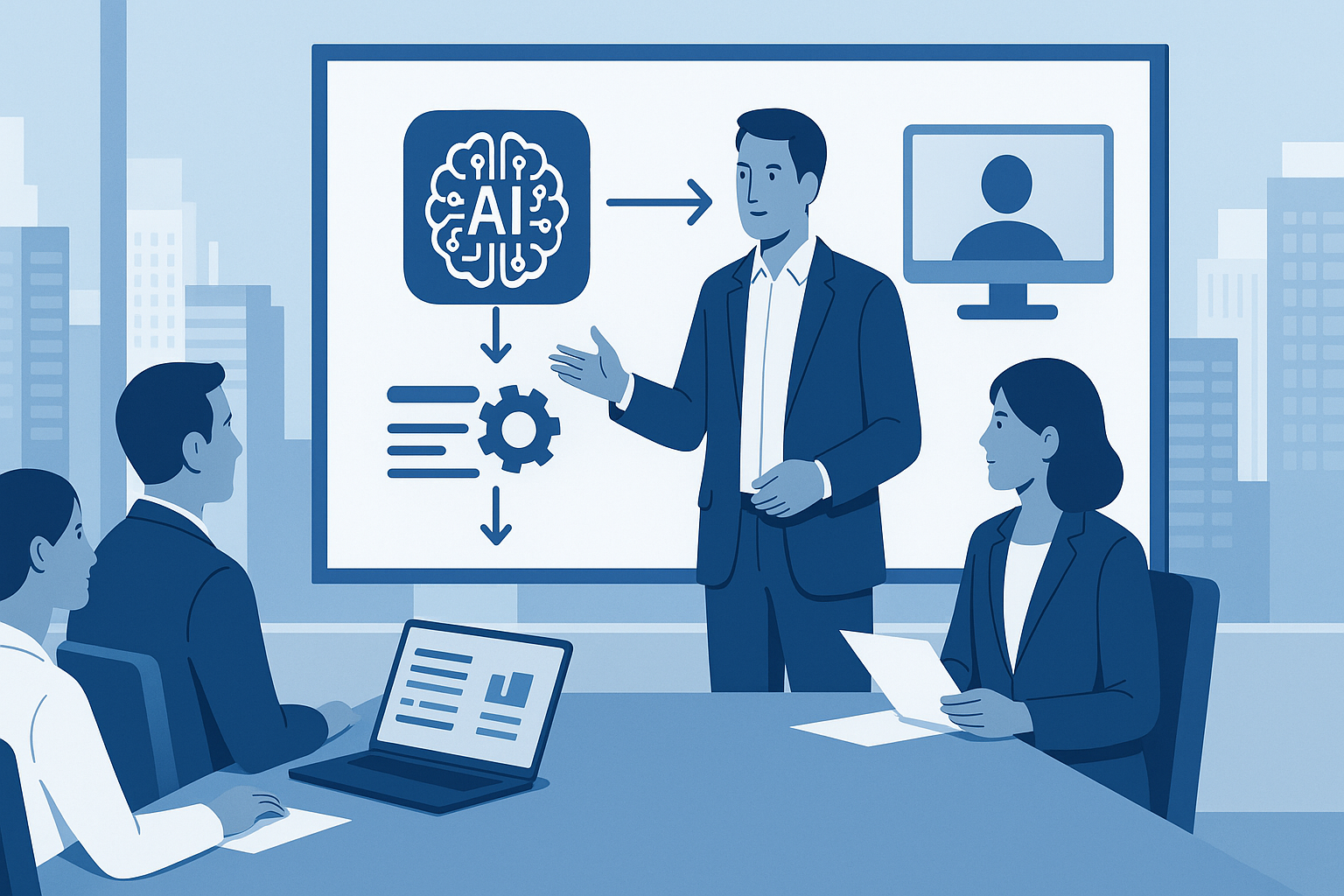

The year of AI tourism is over. Through 2024 and most of 2025, European executive teams spent quarter after quarter debating whether to "explore" artificial intelligence, while their employees were already using it on the side to draft emails and summarise meeting minutes. That phase has closed. The question on the boardroom table has shifted: what processes in your organisation are still being run by humans when they could be orchestrated by agents working alongside them?
Most boardroom conversations on AI start from a flawed assumption: that the transformation model is to swap people for software. In Europe, where the structural bottleneck is qualified talent rather than labour cost, that frame leads to bad calls. Well-implemented AI does not shrink your headcount; it relocates the work inside it. It operates as a cognitive exoskeleton: it amplifies the human you already employ, takes the robotic part of the job off them, and leaves them with the part that actually moves the business.
This article is for the executive who wants to walk into Monday with a different frame. What follows is the reclassification we are seeing work in real engagements with mid-market companies: why your overloaded team is a technology decision before it is an HR decision, and what you have to do this quarter so that AI starts producing EBITDA rather than tweets.
The end of AI tourism
"AI tourism" is easy to spot: a pilot with no metrics, a generative tool subscription so the marketing team can write LinkedIn posts faster, a prompt training that ends in zero process change. The mid-market company that stayed there in 2025 has not moved the indicator that matters. Not a euro of additional margin, not a process redesigned, not a bottleneck removed.
What has changed in the last few months is the maturity of agentic workflows. An agent, in practical terms, is a program that decomposes a task into steps, decides which tools to use (email, ERP, database, external API), executes the sequence and reports back. Eighteen months ago this was a demo promise. Today there are dozens of platforms delivering it with enough reliability for production use in scoped processes.
The threshold that matters for a board is operational. Which repetitive processes in your company consume qualified time without generating any competitive edge? If the honest answer is north of 30%, you have a capacity problem and a morale problem; both are treated with the same instrument.
"I hired you to think": from operators to agent orchestrators
In the European mid-market companies we work with, the typical office manager has stopped processing invoices by hand. They now supervise an agent that reconciles invoices with the ERP, escalates exceptions and learns from the human criteria. McKinsey's State of AI 2024 survey found that the organisations with the highest returns on generative AI had redesigned the underlying workflows before adding the model, not afterwards. The redesign is the work; the model is what makes that redesign profitable.
The organisational consequence is direct. The junior accountant whose day was spent crossing Excel sheets now reviews exceptions, validates criteria and trains the agent so the next exception resolves itself. The salesperson who used to spend 40% of the time updating CRM and writing follow-up emails spends that time on calls with key accounts instead. The operator becomes an orchestrator.
"The right question for every employee is not whether AI can do their job, but which part of their job is robotic, which part is human, and how we separate the two."
That reclassification changes the conversation with the team. Nobody defends keeping mechanical tasks once they understand the alternative is leaving the company through burnout. The retention data we see in clients who have implemented AI focused on removing busywork is consistent in one direction: lower voluntary turnover in the first twelve months, and a much higher capacity to absorb growth without hiring. The "they're coming for our jobs" argument loses force when the first visible effect is that Fridays feel like Fridays again.
Data sovereignty: Europe's SLM advantage
This is where Europe shifts from being seen as a brake to being a real advantage. The AI Act, in force since 2024 with phased application across 2025 and 2026, requires classification by risk level, traceability, and documentation of automated decisions affecting people. For a mid-market company sending sensitive data to a US public cloud, the compliance cost has become serious. For one running smaller models on its own infrastructure, compliance is almost automatic.
Small Language Models (SLMs) are the piece that makes this scenario viable. Models like Microsoft's Phi-3, Mistral 7B or the smaller Llama variants run on modest hardware, deliver enough quality for scoped tasks (classification, extraction, draft writing, internal semantic search) and keep your data inside the company perimeter. For critical processes that do not require frontier-level reasoning, they are the right choice both technically and economically.
When does an SLM make sense compared to a large American provider's model? The practical rule we apply in engagement is straightforward. If the task is repetitive, scoped, and the data is sensitive or regulated, local SLM. If the task requires open reasoning, multimodality or very broad general knowledge, a large model with the appropriate contract and traceability. Most mid-market companies discover that the SLM covers 70-80% of their real use cases at a fraction of the cost and with zero regulatory exposure.
The 20-person SMB with the muscle of 100
The argument that resonates most in the boardroom is about capacity rather than technology. Mid-market European companies have spent years trying to grow with teams they cannot find. Positions open for months, managers covering three levels of function at once, founders going back to operational tasks because nobody can absorb them. The promise of well-used AI is direct: a twenty-person company can operate with the effective capacity of a hundred-person one, without the friction of managing eighty extra people.
The exact number is beside the point; the qualitative shift is what matters. What takes months to hire and additional months to train, a well-configured agent absorbs in weeks. The HR function changes its objective: from "filling vacancies on time" to designing the human-agent combination for each critical role. It is a different conversation, and most boards are not having it yet.
The financial effect also shifts. Revenue growth no longer demands proportional headcount growth. The economies of scale that historically only large corporations enjoyed, in unit costs and in response speed, become accessible to a well-run family business. That reopens competitive territories that looked closed.
How to hire an agent: a 90-day playbook
The operational part. What a CEO or COO can commission on Monday morning without waiting for a twelve-month transformation programme. The playbook we see working in real engagements:
1. Audit processes in bulk, not in the abstract. Take three areas (back office, sales, customer service) and measure what percentage of each role's time goes to mechanical tasks. Skip the long interviews: direct observation for a week. Most boards overestimate the qualified work their team actually does by a factor of two.
2. Pick the three processes with the highest ratio of mechanical time to business impact. Not the easiest ones, not the showiest. The ones that release qualified capacity whose opportunity cost is high. Invoice reconciliation, inbound lead qualification, first-line support. These three are usually candidates in any mid-market company.
3. Design the agent-human flow before picking the tool. Define what the agent does, what requires human validation, what metrics are tracked, and how an exception escalates. If you do this after buying the platform, the platform drives and the result is mediocre.
4. Run the first pilot with two people and one agent, not with a committee. Thirty days of real operation, daily metrics, comparison against baseline. Slow pilots die because they lose sponsorship before they generate useful data.
5. Close the loop with the people doing the work. The employee who now supervises the agent must be able to correct it, adjust it, and teach it new exceptions. If you depend on the vendor for every change, the system ages in six months.
6. Measure in EBITDA, not in hours saved. Hours saved is an intermediate metric. The board wants to see margin impact, faster sales cycles, or reduction of errors with real cost attached. Tie every deployed agent to a financial KPI before scaling it to another area.
Ninety days is a deliberate window: it is the time in which the board can decide, with data in hand, whether the investment continues, before organisational inertia turns the pilot into a zombie initiative.
Five questions your board should resolve this quarter
If you only take one thing from this article, take this list. Five questions to bring into the next executive meeting and to be answered with data before quarter-end.
1. What percentage of my qualified team's time goes to mechanical tasks? If nobody knows for sure, every other answer rests on intuition. It has to be measured.
2. Which critical processes handle data that cannot leave Europe? That list defines what runs on a local SLM and what runs on a cloud provider. Without that segmentation, platform decisions come backwards.
3. Which critical role have I had open for more than six months? Each one is a candidate to be partially covered by a human-agent combination while still being filled with a person, not afterwards.
4. Which key employee is at risk of leaving from operational burnout? Those are the first candidates to receive their cognitive exoskeleton. The investment pays back through retention before it pays back through productivity.
5. Who on my executive team is accountable for deciding this? If the answer is "everyone" or "nobody clearly", the organisation will spend another year doing AI tourism. It needs a single owner with a calendar and a metric.
Where is your hidden bench?
The hidden bench, in capacity terms, is the gap between what your current team would produce if it could dedicate itself to qualified work and what it actually produces today, trapped in busywork. In most European mid-market companies we have seen in the last twelve months, that hidden bench represents between 25% and 40% of total company capacity: revenue growth without hiring, sitting there, waiting for someone to release it.
The cognitive exoskeleton describes precisely what happens when a qualified human works on top of a well-designed set of agents. They produce more, decide better, and absorb the pace of growth without breaking. What your board has to decide now is the calendar. The competitor next door is already activating theirs; the only open question is whether you do it this quarter or the next. And if you decide it is this one, building and operating that exoskeleton is exactly what we do in Enterprise AI Implementation.